Post-Fracture Rehabilitation: What to Expect After Cast Removal & How to Restore Full Movement

7+ Years Exp
Important Medical Disclaimer
The information provided in this article is for educational purposes and is quite generic. While general clinical guidelines are often helpful, they cannot replace a professional medical diagnosis. We strongly advise you to consult with a certified physiotherapist or doctor before attempting any home treatments or exercises described here.
The Reality of Cast Removal: Healing Bone vs. Stiff Joints
Having a plaster cast or fiberglass splint removed is a major milestone in fracture healing. However, patients are often shocked to find that their limb is thin, weak, dry, and severely stiff. A wrist, ankle, or elbow that was immobilized for 6 to 8 weeks cannot simply bend or bear weight immediately.
Immobilization causes:
- Capsular Adhesions: The joint capsule thickens and adheres to surrounding cartilage.
- Muscle Atrophy: Up to 30% of muscle mass is lost within weeks of disuse.
- Loss of Proprioception: Joint position receptors become sluggish, creating a feeling of instability and fear of falling.
- Disuse Osteopenia: The bone itself requires progressive mechanical loading to regain full cortical density.
When Should Physiotherapy Start After a Fracture?
Physiotherapy should begin the very day or within 24 hours of cast removal. Waiting weeks allows adhesions to calcify, turning temporary joint stiffness into permanent contractures that may require surgical manipulation under anesthesia.
Phases of Post-Fracture Rehabilitation
Phase 1: Edema Reduction & Gentle ROM (Weeks 1-2)
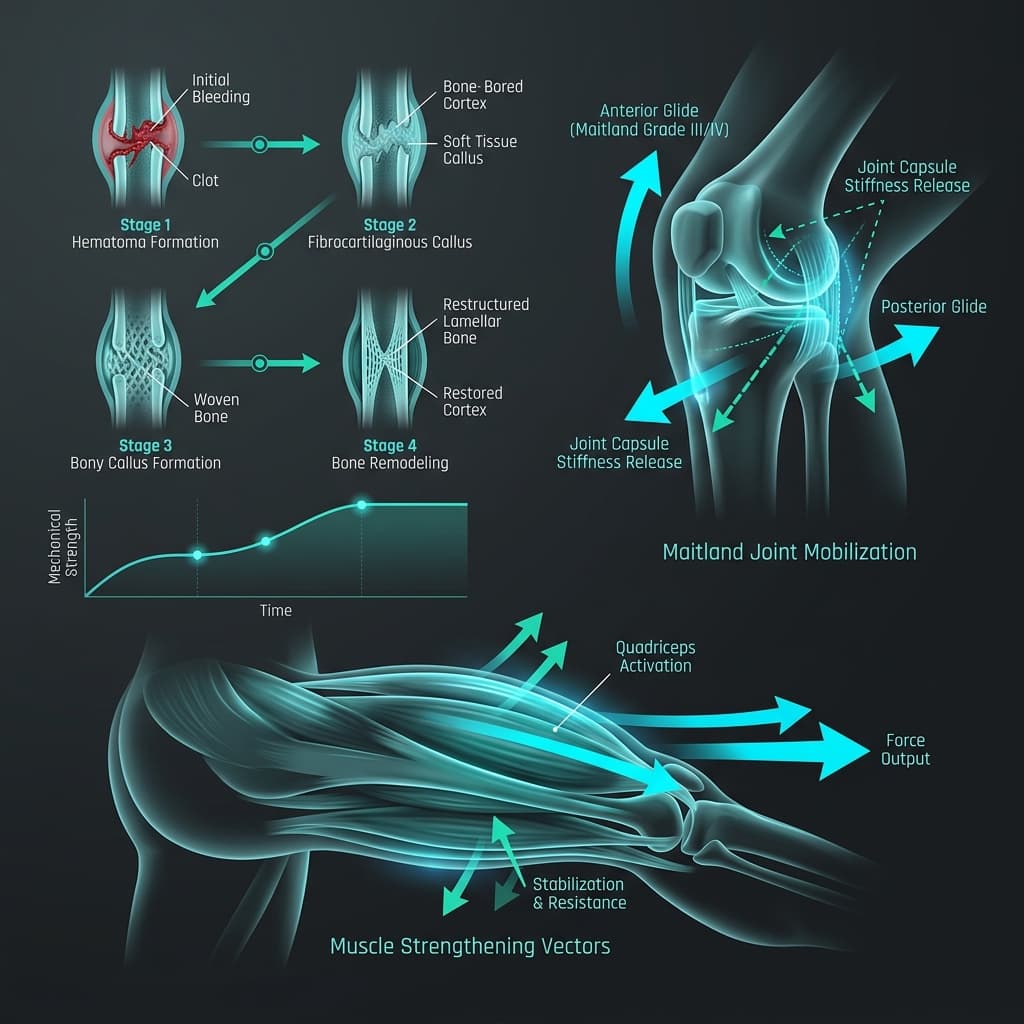
Gentle retrograde lymphatic massage and therapeutic ultrasound reduce lingering swelling. Maitland Grade I/II passive and active-assisted range-of-motion exercises gently stretch the tight joint capsule without stressing the newly formed bone callus.
Phase 2: Progressive Joint Mobilization & Isometrics (Weeks 3-6)
As bone union strengthens on X-ray, therapists introduce Maitland Grade III/IV joint glides, isometric muscle contractions, and resistance bands to wake up dormant motor units.
Phase 3: Full Weight-Bearing & Functional Loading (Weeks 7+)
Progressive closed-kinetic-chain exercises (squats, step-ups, push-ups) stimulate osteoblasts via the piezoelectric effect, remodeling the bone into dense, fracture-resistant structural bone.
Athletlance provides dedicated post-fracture home visit physiotherapy across Miyapur, Kondapur, Gachibowli, Tellapur, and greater Hyderabad. Get back to normal daily activities with confidence.
Questions Answered In This Article
Fracture rehabilitation should begin immediately (within 24-48 hours) after cast removal or surgical clearance to reverse joint stiffness, reduce edema, and restore full muscle strength.
Related Recovery & Rehab Guides
Avoiding Back Surgery: How Manual Physiotherapy Cures Sciatica & Slip Disc
Suffer from shooting leg pain or chronic lower back stiffness? Discover how advanced manual therapy mobilizations (Mulligan & Maitland) restore disc health without spinal surgery.
Total Knee Replacement Recovery: A Guide for Jubilee Hills Residents
Recovering from a TKR surgery? Discover why early, supervised home physiotherapy is crucial for restoring full knee bending and walking safely.

Frozen Shoulder (Adhesive Capsulitis): Non-Surgical 3-Stage Recovery Guide in Hyderabad
Severe shoulder stiffness and night pain? Learn how clinical Maitland mobilization, capsular release, and targeted home physiotherapy unfreeze the shoulder without painful surgery in Hyderabad.