Shoulder Pain at Night: Red Flags, Causes, and When to Get Emergency Help

6+ Years Exp
Important Medical Disclaimer
The information provided in this article is for educational purposes and is quite generic. While general clinical guidelines are often helpful, they cannot replace a professional medical diagnosis. We strongly advise you to consult with a certified physiotherapist or doctor before attempting any home treatments or exercises described here.
Why Does Shoulder Pain Always Worsen at 2 AM?
One of the most universal complaints heard at our Miyapur clinic is: "Doctor, during the day I can manage my work, but the moment I lie down in bed at night, my shoulder throbs like a severe toothache." This is not in your imagination; it is rooted in human anatomy and vascular mechanics.
The Anatomy of Nighttime Shoulder Throbbing
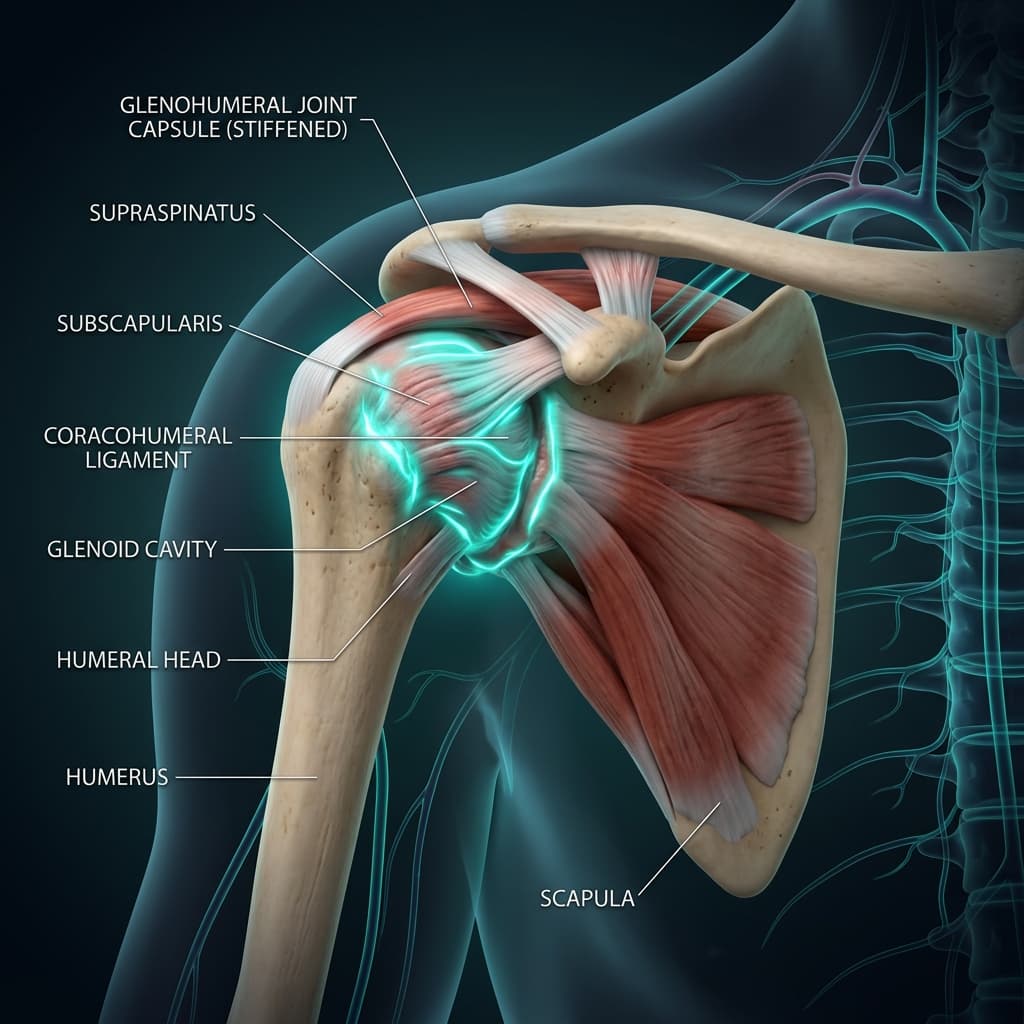
During the day when you stand or sit, the weight of your arm provides natural downward traction, opening up the narrow subacromial space between the humerus and the acromion bone. When you lie horizontally in bed, this gravitational traction disappears. The head of the humerus drifts upwards, pinching the subacromial bursa and the supraspinatus tendon.
How to Tell Which Condition You Have
- Rotator Cuff Tendinopathy: Pain triggers sharply when lifting your arm between 60 and 120 degrees (the painful arc), but your passive range is fully preserved when someone else moves your arm.
- Frozen Shoulder (Capsulitis): Both active and passive ranges are severely blocked; you cannot rotate your arm outward (external rotation) regardless of pain.
- Calcific Tendinitis: Sudden, excruciating onset resembling a fracture, often accompanied by warm skin over the joint.
- Cardiac Red Flag: If left shoulder ache is accompanied by chest tightness, shortness of breath, radiating jaw pain, or cold sweating, seek emergency cardiac care immediately.
Condition Overview
Common Symptoms
- Sudden intense awakening whenever rolling onto the affected shoulder
- Deep, dull, toothache-like throb radiating down the outside of the arm to the elbow
- Inability to find any comfortable sleeping position with your arm rested
- Severe weakness when trying to hold an arm extended sideways
Why It Occurs (Causes)
- Subacromial bursa compression when horizontal, eliminating gravity decompression
- Relative hypovascularity (critical zone) of the supraspinatus tendon at rest
- Inflammatory cytokine pooling in the joint space during nighttime immobility
- Referred cervical spine radiculopathy originating from C5-C6 discs
How To Avoid It (Prevention)
- Sleep in side-lying position on the opposite side with a supporting pillow hugged under the arm
- Perform gentle Codman pendulum circles for 2 minutes before getting into bed
- Apply ice or moist heat for 15 minutes before sleep to calm local nociceptors
- Get a clinical shoulder evaluation before microtears become full-thickness tears
Questions Answered In This Article
Physiotherapy is a natural, hands-on approach to healing that helps you live pain-free without relying heavily on medication or surgery. At Athletlance, we don't just treat the symptoms; we take the time to find the root cause of your pain—whether it's a pinched nerve, weak muscles, or stiff joints—so you can safely get back to doing what you love.
A standard session usually lasts between 45 to 60 minutes. We never want you to feel rushed, so this gives us plenty of time to carefully assess your progress, perform hands-on therapy, and guide you through your exercises at a pace that feels right for you.
Because every body heals differently, there is no one-size-fits-all answer. Some minor strains feel better in just 2 to 3 sessions, while post-surgery rehab or stroke recovery takes several weeks of consistent care. After your first assessment, we will give you a clear, honest timeline of what to expect for your specific journey.
Every patient's healing journey is unique. If you are in severe pain, we might suggest daily sessions for the first few days to bring you quick relief. For long-term rehab, 3 times a week is standard. During your first visit, we will sit down with you and design a recovery schedule that fits both your healing needs and your daily life.
Related Recovery & Rehab Guides
'Take Bed Rest' — The Worst Medical Advice for Back Pain (And What To Do Instead)
Prolonged bed rest weakens spinal muscles, stiffens joints, and starves your discs of nutrition. Discover what 30 years of spinal research recommends instead to eliminate back pain quickly.
Diastasis Recti & Pelvic Floor Recovery: The Definitive Clinical Wiki on Linea Alba Healing, Core Pressure & Safe Exercise
Noticing an abdominal bulge or 'pooch' months after delivery? Learn how to measure Inter-Recti Distance (IRD), manage intra-abdominal pressure, activate the deep transverse abdominis corset, and heal Diastasis Recti in Hyderabad.
Fibromyalgia & Chronic Pain: How Neuroscience-Based Physiotherapy Breaks the Pain Cycle
Living with widespread body aches, chronic fatigue, and hypersensitivity? Learn how pain neuroscience education, graded motor imagery, and gentle pacing retrain an overactive nervous system in Hyderabad.