Your MRI Shows a 'Bulging Disc' — Here's Why That's Probably Not Your Problem

7+ Years Exp
Important Medical Disclaimer
The information provided in this article is for educational purposes and is quite generic. While general clinical guidelines are often helpful, they cannot replace a professional medical diagnosis. We strongly advise you to consult with a certified physiotherapist or doctor before attempting any home treatments or exercises described here.
The Epidemic of 'VOMIT' (Victims of Medical Imaging Technology)
In the medical research world, there is a recognized phenomenon humorously termed VOMIT: Victims of Modern Imaging Technology. When a patient in Hyderabad develops an acute back spasm, they frequently rush to an imaging center for an MRI. The report comes back with alarming terminology: "L4-L5 diffuse annular disc bulge, disc desiccation, facet arthropathy, and thecal sac indent." Fear sets in, and patients immediately assume their spine is broken.
What the Medical Research Actually Proves
Landmark studies published in the New England Journal of Medicine and the American Journal of Neuroradiology evaluated MRIs of thousands of completely asymptomatic adults with zero back pain:
- 37% of 20-year-olds with zero pain have disc bulges.
- 60% of 50-year-olds have disc protrusions without knowing it.
- 80% of 70-year-olds show marked disc degeneration and height loss.
Disc bulges are often the spinal equivalent of grey hair or facial wrinkles — normal hallmarks of human maturity, not an automatic death sentence for your spine.
Clinical Examination Trumps Static Pictures
An MRI takes a picture of you lying flat on your back inside a cool magnetic tube without bearing gravity. But you live, sit, walk, and twist against gravity. At Athletlance, our physiotherapists test your spine dynamically under load, isolating whether pain originates from the disc, the facet joint, the sacroiliac joint, or deep gluteal myofascial knots.
Condition Overview
Common Symptoms
- Severe anxiety after reading MRI radiology report terms like 'desiccation'
- Fear of bending or lifting anything heavier than a cup of water
- Pain location not matching the spinal level highlighted in the scan
- Symptoms that fluctuate radically from morning to evening
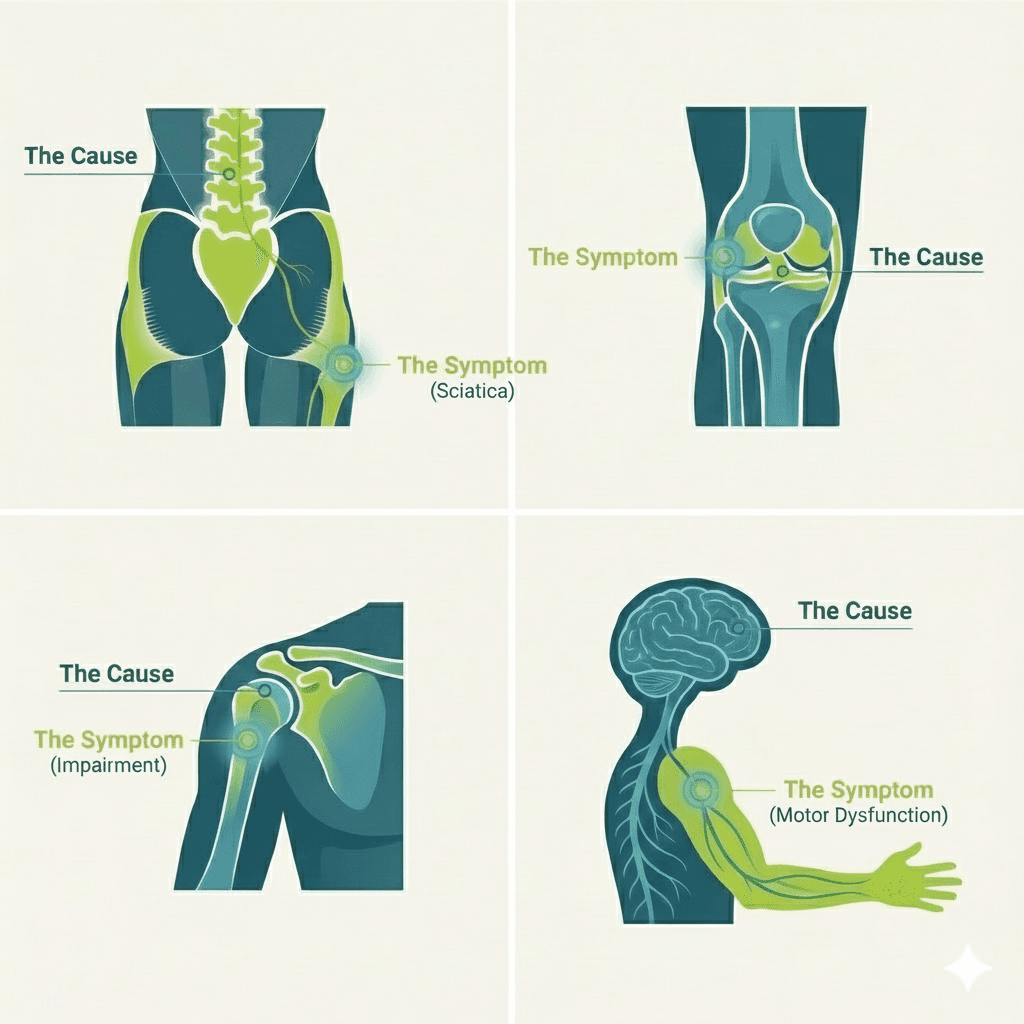
Why It Occurs (Causes)
- Normal anatomical aging changes mistaken for acute spine pathology
- Static supine imaging that fails to show dynamic weight-bearing kinematics
- Neglecting sacroiliac joint dysfunction and piriformis myofascial trigger points
How To Avoid It (Prevention)
- Always correlate imaging findings with hands-on mechanical testing
- Avoid immediate surgery solely based on an asymptomatic scan finding
- Maintain active spinal mobility through graded directional extensions
- Seek clinical evaluation from certified BPT/MPT physiotherapists
Questions Answered In This Article
Physiotherapy is a natural, hands-on approach to healing that helps you live pain-free without relying heavily on medication or surgery. At Athletlance, we don't just treat the symptoms; we take the time to find the root cause of your pain—whether it's a pinched nerve, weak muscles, or stiff joints—so you can safely get back to doing what you love.
A standard session usually lasts between 45 to 60 minutes. We never want you to feel rushed, so this gives us plenty of time to carefully assess your progress, perform hands-on therapy, and guide you through your exercises at a pace that feels right for you.
Because every body heals differently, there is no one-size-fits-all answer. Some minor strains feel better in just 2 to 3 sessions, while post-surgery rehab or stroke recovery takes several weeks of consistent care. After your first assessment, we will give you a clear, honest timeline of what to expect for your specific journey.
Every patient's healing journey is unique. If you are in severe pain, we might suggest daily sessions for the first few days to bring you quick relief. For long-term rehab, 3 times a week is standard. During your first visit, we will sit down with you and design a recovery schedule that fits both your healing needs and your daily life.
Related Recovery & Rehab Guides
Elite Sports Recovery at Home: Cupping & Dry Needling in Hyderabad
Overtraining? Muscle spasms? Experience clinical-grade sports recovery including dry needling, cupping, and deep tissue release in the comfort of your home.

Knee Osteoarthritis (OA) Clinical Wiki: Kellgren-Lawrence Stages, Cartilage Biomechanics & Evidence-Based Joint Preservation
Told your knee is 'bone-on-bone'? Read the clinical facts on Kellgren-Lawrence OA stages, cartilage nutrition, VMO muscle shielding, and how targeted physiotherapy prevents total knee replacement surgery in Hyderabad.

Vertigo & BPPV: How Physiotherapy Stops the World From Spinning
Sudden, intense spinning when turning over in bed? You likely have BPPV. Discover how the Epley Maneuver and vestibular physiotherapy provide rapid, drug-free relief in Hyderabad.