Vertigo & BPPV: How Physiotherapy Stops the World From Spinning

7+ Years Exp
Important Medical Disclaimer
The information provided in this article is for educational purposes and is quite generic. While general clinical guidelines are often helpful, they cannot replace a professional medical diagnosis. We strongly advise you to consult with a certified physiotherapist or doctor before attempting any home treatments or exercises described here.
What Is BPPV and Why Does It Happen?
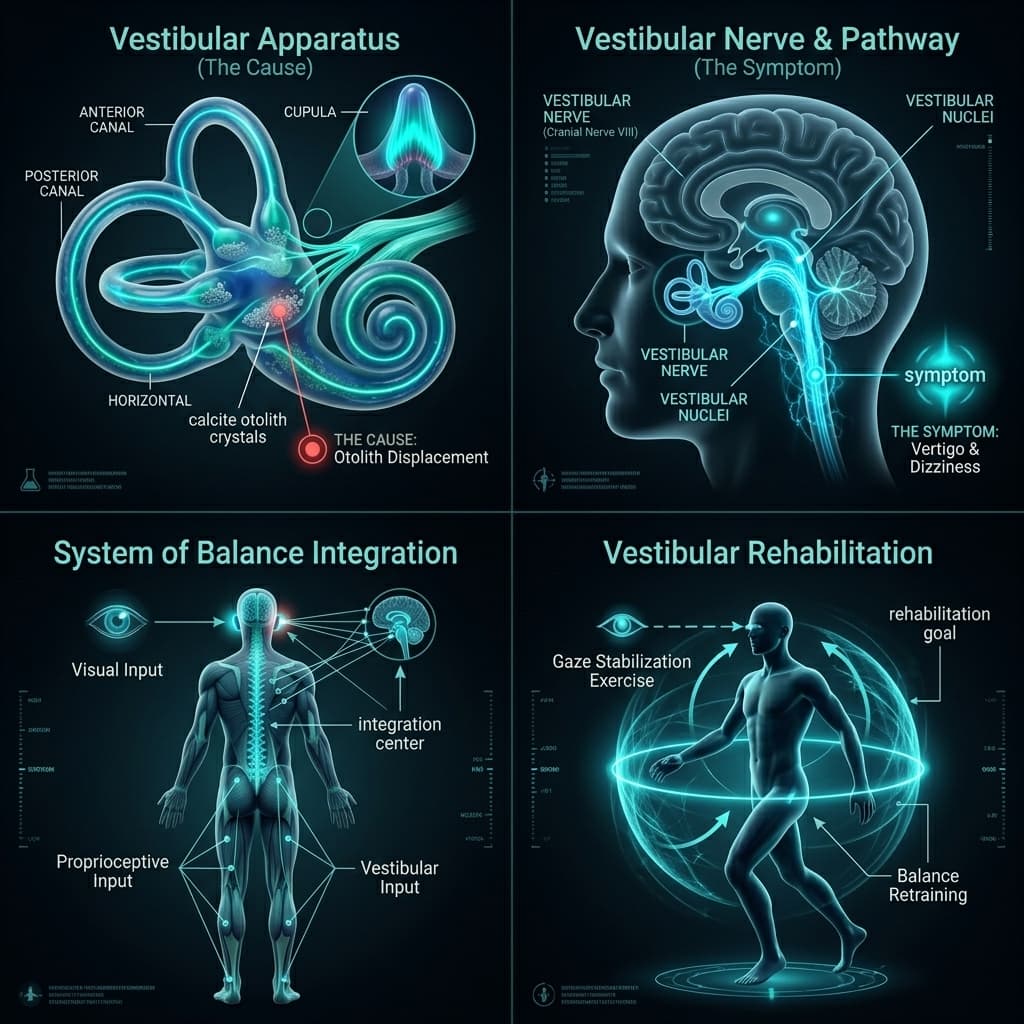
Benign Paroxysmal Positional Vertigo (BPPV) is the most common cause of vertigo, accounting for nearly 50% of all dizziness complaints. It occurs when tiny calcium carbonate crystals (otoconia or "ear rocks") become dislodged from their normal position inside the inner ear and migrate into one of the fluid-filled semicircular canals.
When you move your head — rolling over in bed, looking up at a high shelf, or bending forward — these misplaced crystals move within the canal fluid and send false movement signals to the brain, causing intense spinning sensations (vertigo) that typically last 10-60 seconds.
The Epley Maneuver: A Cure in Minutes
The remarkable news about BPPV is that it can be cured without medication. The Epley Canalith Repositioning Maneuver is a sequence of carefully guided head movements performed by a trained physiotherapist to guide the displaced crystals back to their correct position.
In clinical studies, a single Epley Maneuver session resolves BPPV symptoms in over 80% of patients. Multiple sessions resolve over 95% of cases. Our vestibular physiotherapy home visits are particularly valuable for elderly patients and those who find traveling during a vertigo episode dangerous.
Other Vestibular Conditions We Treat
- Vestibular Neuritis: Viral inflammation of the vestibular nerve causing sudden, severe, constant vertigo.
- Labyrinthitis: Inner ear infection causing both vertigo and hearing changes.
- Persistent Postural-Perceptual Dizziness (PPPD): Chronic dizziness that persists after the initial episode, worsened in crowded environments.
- Post-Concussion Dizziness: Vestibular dysfunction following a head injury.
Vestibular Rehabilitation Exercises
For conditions beyond BPPV, we prescribe a structured programme of vestibular rehabilitation exercises:
- Gaze Stabilization (VOR Exercises): Keeping your eyes fixed on a target while moving your head to retrain the vestibulo-ocular reflex.
- Habituation Exercises: Deliberately exposing yourself to the triggering positions to reduce the brain's sensitivity over time.
- Balance Training: Progressively challenging your balance on stable and unstable surfaces to rebuild confidence.
If you are experiencing sudden spinning, chronic dizziness, or fear of falling due to balance issues, our vestibular specialists provide home visit assessments across Hyderabad. Most patients experience significant improvement within 2-4 sessions.
Related Recovery & Rehab Guides
Stroke Rehabilitation at Home: The Critical Role of Early NDT Physiotherapy
Discover how Neuro-Developmental Treatment (NDT) and early home-based stroke rehabilitation restore mobility, hand function, and independence for paralysis survivors in Hyderabad.
Parkinson's Disease: Physiotherapy for Gait, Balance & Fall Prevention
Is your loved one shuffling their feet or freezing mid-step? Discover how specialized Parkinson's physiotherapy using LSVT BIG and cueing strategies can dramatically reduce fall risk and improve mobility.
Physiotherapy for Bedridden Patients: Preventing Complications at Home
Prolonged bed rest leads to severe muscle wasting, bedsores, and chest infections. Learn how our expert home-visit physiotherapists manage bedridden care in Hyderabad.