BPPV & Vertigo Clinical Reference: Semicircular Canal Mechanics, Dix-Hallpike Diagnosis & Canalith Repositioning Protocols
6+ Years Exp
Important Medical Disclaimer
The information provided in this article is for educational purposes and is quite generic. While general clinical guidelines are often helpful, they cannot replace a professional medical diagnosis. We strongly advise you to consult with a certified physiotherapist or doctor before attempting any home treatments or exercises described here.
1. Anatomy of the Inner Ear Vestibular Apparatus
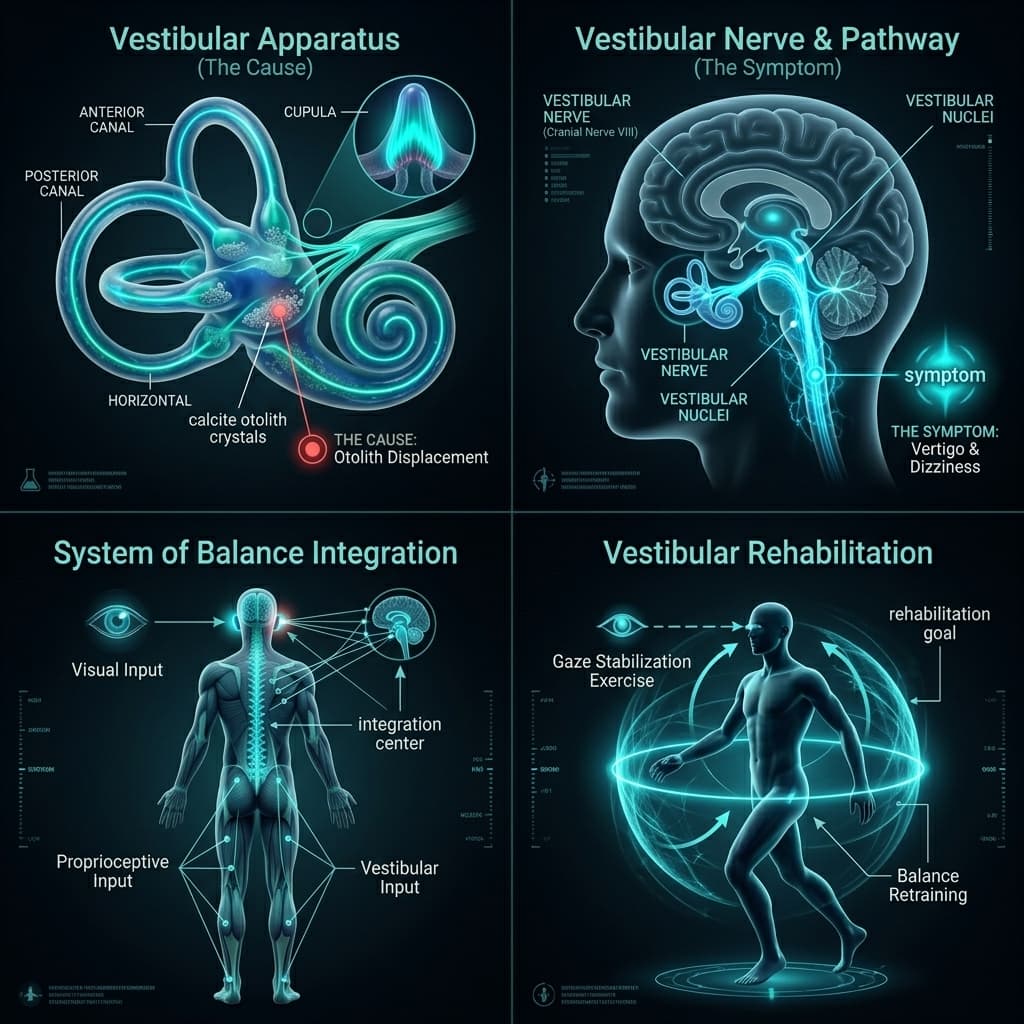
The human vestibular system located within the petrous temporal bone of the inner ear controls equilibrium and spatial orientation. It consists of two otolith organs (the utricle and saccule) and three orthogonal fluid-filled Semicircular Canals (Posterior, Horizontal, and Superior).
The utricle contains microscopic calcium carbonate crystals called otoconia embedded in a gelatinous membrane. When these crystals dislodge due to head trauma, vestibular aging, or inner ear viral infections, they float into one of the fluid-filled semicircular canals (most commonly the posterior canal, due to gravity).
2. Pathomechanics: Canalithiasis vs. Cupulolithiasis
In Canalithiasis (90% of BPPV cases), free-floating otoconia particles drift through the endolymph fluid when the head moves. Their gravitational pull creates abnormal fluid currents that deflect the cupula hair cells, sending violent false signals to the brain that the head is spinning rapidly, producing intense rotational vertigo and involuntary rhythmic eye movements (nystagmus).
3. The Gold Standard Diagnostic: Dix-Hallpike Test
Our certified vestibular physiotherapists perform the Dix-Hallpike maneuver:
- The patient sits on the examination table with head rotated 45 degrees toward the tested ear.
- The patient is swiftly lowered backward into a supine position with the neck extended 20 degrees over the table edge.
- The examiner observes the eyes: A latency period of 2-5 seconds followed by torsional upbeating nystagmus and vertigo lasting under 60 seconds confirms posterior canal canalithiasis of the dependent ear.
4. The Epley Canalith Repositioning Maneuver
The Epley maneuver utilizes precise 90-degree rotational shifts guided by gravity to migrate the displaced otoconia out of the posterior semicircular canal and safely back into the utricular cavity, where they are naturally reabsorbed.
Clinical Success Rate: Over 85% of BPPV cases are completely cured in a single Epley session, and over 95% within two sessions, permanently eliminating the need for labyrinthine sedative medications (like cinnarizine or betahistine).
5. Vestibular Rehabilitation Therapy (VRT) for Residual Imbalance
Following crystal repositioning, patients with residual lightheadedness undergo:
- Gaze Stability Exercises (VOR x1 & VOR x2): Training the vestibulo-ocular reflex to keep visual focus sharp during head movement.
- Brandt-Daroff Exercises: Habituation drills that desensitize the vestibular centers in the cerebellum.
- Dynamic Computerized Balance Retraining: Standing on foam surfaces with eyes closed to reinforce proprioceptive reliance.
Don't live with debilitating dizziness. Athletlance provides specialized in-home and clinic vestibular rehabilitation across Miyapur, Beeramguda, Banjara Hills, Jubilee Hills, and all of Hyderabad.
Questions Answered In This Article
Our certified vestibular physiotherapists perform the Dix-Hallpike diagnostic test and apply the Epley canalith repositioning maneuver, which cures over 85-90% of BPPV cases in just 1 to 2 sessions without medication.
Related Recovery & Rehab Guides
Avoiding Back Surgery: How Manual Physiotherapy Cures Sciatica & Slip Disc
Suffer from shooting leg pain or chronic lower back stiffness? Discover how advanced manual therapy mobilizations (Mulligan & Maitland) restore disc health without spinal surgery.

Total Knee Replacement Recovery: A Guide for Jubilee Hills Residents
Recovering from a TKR surgery? Discover why early, supervised home physiotherapy is crucial for restoring full knee bending and walking safely.
Frozen Shoulder (Adhesive Capsulitis): Non-Surgical 3-Stage Recovery Guide in Hyderabad
Severe shoulder stiffness and night pain? Learn how clinical Maitland mobilization, capsular release, and targeted home physiotherapy unfreeze the shoulder without painful surgery in Hyderabad.