Stroke Rehabilitation at Home: The Critical Role of Early NDT Physiotherapy

7+ Years Exp
Important Medical Disclaimer
The information provided in this article is for educational purposes and is quite generic. While general clinical guidelines are often helpful, they cannot replace a professional medical diagnosis. We strongly advise you to consult with a certified physiotherapist or doctor before attempting any home treatments or exercises described here.
The Critical Window for Stroke Recovery
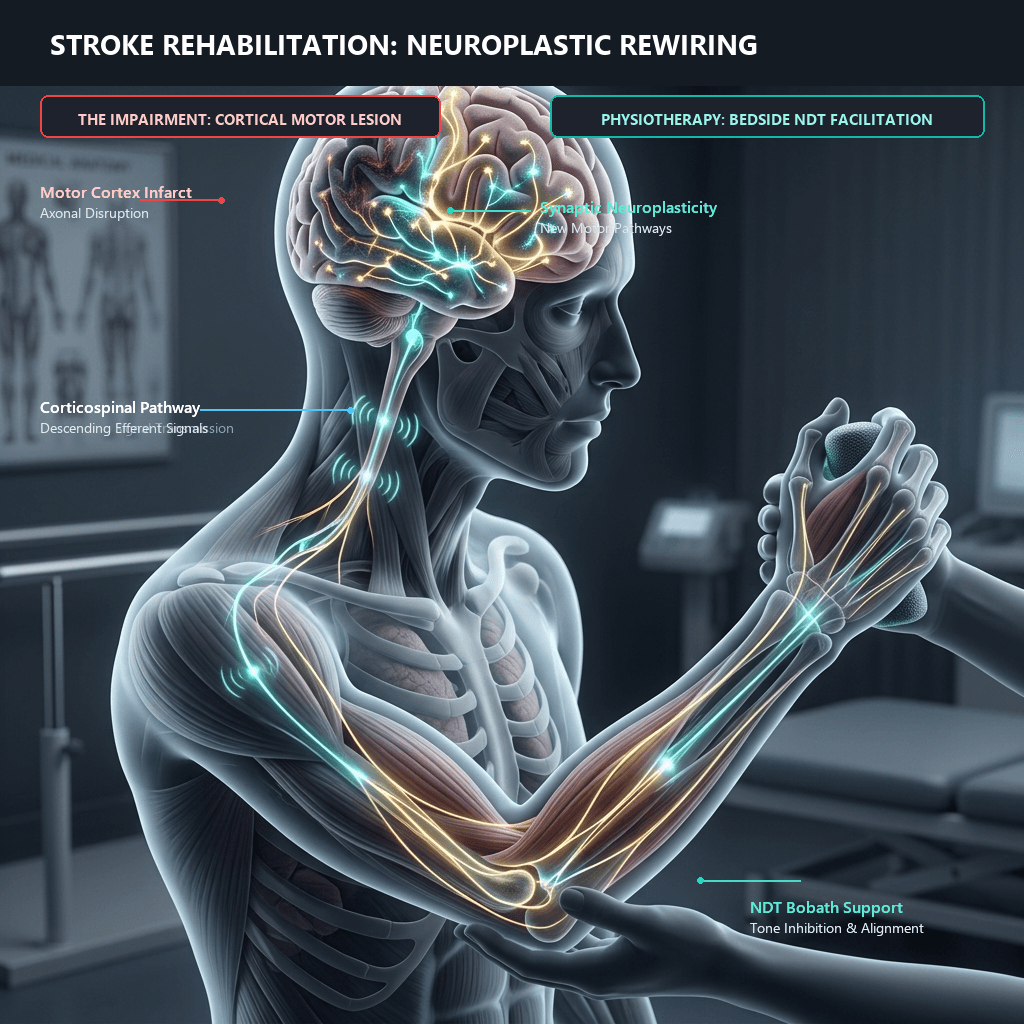
A stroke or paralysis is a life-altering event. When a blood clot or bleed cuts off oxygen to the brain, motor pathways are damaged, leading to hemiplegia (weakness on one side of the body). The first 3 to 6 months after a stroke represent the 'Critical Golden Window' of recovery.
During this period, the brain exhibits high neuroplasticity—the ability to reorganize itself, form new neural connections, and re-learn lost movements. Delayed physiotherapy often leads to joint stiffness, muscle spasticity, and permanent disability.
What is Neuro-Developmental Treatment (NDT)?
At Athletlance, our neurologically trained physiotherapists use the Bobath Concept or Neuro-Developmental Treatment (NDT). Unlike simple stretching, NDT focuses on inhibiting abnormal movement patterns (like spastic curling of the arm) and facilitating normal, functional movement.
We work directly on restoring:
- Postural Control: Learning to sit and stand straight without leaning.
- Weight Transfer: Shifting weight onto the affected leg to prepare for walking.
- Fine Motor Skills: Retraining hand movements like grasping, writing, and holding cups.
Why Home Visit Rehab is Superior for Stroke Patients
Traveling to a clinic in a crowded city like Hyderabad is exhausting and dangerous for a stroke survivor. Furthermore, clinic exercises do not always translate to home independence.
Home-based rehabilitation allows the therapist to:
- Train the patient on their own bed, chair, and toilet setup.
- Identify and eliminate fall hazards in the patient's actual living environment.
- Involve family members directly in daily transfer and safety protocols.
Clinical Milestones of Our Stroke Program
Our program is divided into structured clinical phases:
- Phase 1 (Flaccid Phase): Preventing bedsores, joint contractures, and performing passive range-of-motion exercises.
- Phase 2 (Spasticity Control): Using NDT handling to reduce muscle stiffness and encourage active-assisted movements.
- Phase 3 (Functional Independence): Gait training, stair climbing, and fine-motor activities of daily living (ADLs).
If you or your loved one needs expert paralysis rehab home visits in Miyapur, Kukatpally, or Banjara Hills, contact our specialized team immediately to begin recovery during the golden neuroplastic window.
Questions Answered In This Article
Our neurological specialist Dr. Thanmayi provides early low-frequency electrical muscle stimulation, neuromuscular facial re-education, mirror biofeedback, and gentle facial massage. Starting within the first 1-2 weeks optimizes recovery of facial symmetry, eyelid closure, and smile control while preventing abnormal synkinesis.
Yes. Helping patients recover from neurological conditions like stroke is a dedicated focus for our team. We use gentle, proven techniques (like NDT and PNF) to help stroke survivors regain their mobility, rebuild their balance, and safely return to their daily lives.
Neuro-Developmental Treatment (NDT) is a hands-on clinical therapy designed to retrain the brain to control muscles and restore normal movement patterns after a neurological injury.
Physiotherapy should start within 24 to 48 hours of medical stabilization, even in the hospital, to prevent muscle wasting and joint stiffness.
In the acute phase, daily sessions (5-6 days a week) are highly recommended to maximize neuroplasticity, which can transition to 3 sessions a week as the patient regains independence.
Related Recovery & Rehab Guides
Parkinson's Disease: Physiotherapy for Gait, Balance & Fall Prevention
Is your loved one shuffling their feet or freezing mid-step? Discover how specialized Parkinson's physiotherapy using LSVT BIG and cueing strategies can dramatically reduce fall risk and improve mobility.
Vertigo & BPPV: How Physiotherapy Stops the World From Spinning
Sudden, intense spinning when turning over in bed? You likely have BPPV. Discover how the Epley Maneuver and vestibular physiotherapy provide rapid, drug-free relief in Hyderabad.
Physiotherapy for Bedridden Patients: Preventing Complications at Home
Prolonged bed rest leads to severe muscle wasting, bedsores, and chest infections. Learn how our expert home-visit physiotherapists manage bedridden care in Hyderabad.